Client: Leading Retail Chain with 300+ Stores Nationwide
Industry: Retail & E-commerce
Engagement Duration: 3 Months
Technology Stack: Microsoft Fabric, Power BI, Azure Data Factory
Business Challenge
The client struggled with fragmented data silos across sales, inventory, customer loyalty, and marketing systems. Reporting processes were heavily manual, inconsistent, and lacked strategic clarity.
Key Challenges:
- No real-time visibility into store-level performance
- Inability to track cross-departmental KPIs effectively
- Lack of data security segmentation—all users had uniform access
- Disconnected dashboards without personalized or contextual insights
Our Solution: Microsoft Fabric–Powered Unified Data Platform
To address these gaps, we implemented a centralized, role-based data architecture using Microsoft Fabric and Power BI. The solution delivered secure, scalable, and actionable insights tailored to each user profile.
1. Unified Data Lake Architecture
- Ingested structured and semi-structured data from POS, CRM, ERP, and marketing systems
- Designed a lakehouse architecture to support both exploratory and analytical workloads
- Leveraged Delta Lake tables to ensure performance and scalability
2. Automated Data Pipelines & Transformation
- Deployed Fabric Data Pipelines (based on Azure Data Factory) for ingestion, cleansing, and transformation
- Created semantic models to track core KPIs such as:
- Sales performance
- Customer retention
- Inventory turnover
- Store-level profitability
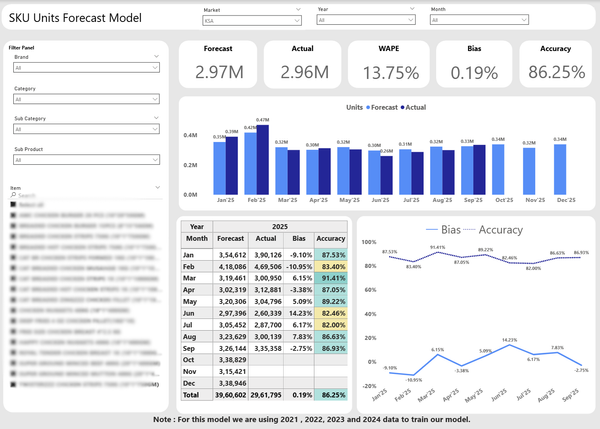
3. Interactive Power BI Dashboards
Customized dashboards were designed to deliver role-specific insights:
- Executives: Company-wide performance, YoY growth, and margin analysis
- Regional Managers: Store-level KPIs, inventory trends, and operational alerts
- Marketing Teams: Campaign performance, customer engagement, and ROI tracking
4. Role-Based Access with Row-Level Security (RLS)
- Implemented Row-Level Security in Power BI to enforce access restrictions by role and region
- Integrated with Azure Active Directory (AAD) to enable seamless Single Sign-On (SSO) and identity-based control
5. Personalized & Embedded User Experience
- Dashboards dynamically adjusted based on user profiles:
- Region
- Department
- Access Level
- Insights were embedded within Microsoft Teams and SharePoint to promote real-time decision-making and collaboration
Key Takeaway
By centralizing their data ecosystem on Microsoft Fabric and applying Power BI with secure, personalized access, the client unlocked real-time visibility, cross-functional alignment, and operational agility across 300+ retail locations. This transformation turned disconnected reports into a unified, intelligent decision-making platform—scalable, secure, and built for the future of retail.
Would you like to explore how Navtics can transform your business? Netision Experts are here to help you.