Case Study: Enhancing Sales Forecasting Accuracy with Machine Learning for a National Electronics Retailer
Client: National Consumer Electronics Retailer
Industry: Retail (D2C + Offline)
Engagement Timeline: 3 Months
Objective: Improve sales forecasting accuracy to optimize inventory planning, marketing efficiency, and annual budgeting
Technology Stack: Python, Snowflake, Power BI, Azure ML
Business Challenge
The client relied on traditional forecasting methods—such as moving averages and manual trend extrapolation—which failed to capture real-world complexity and seasonal variability. This led to:
- Forecasting errors exceeding 25% during seasonal peaks like Black Friday and Diwali
- Inventory misalignment, including overstocking of slow-moving SKUs and understocking during promotions
- Inefficient marketing spend due to inaccurate demand predictions
- Disrupted supply chain planning and missed revenue opportunities
Our Solution: ML-Powered Forecasting Engine
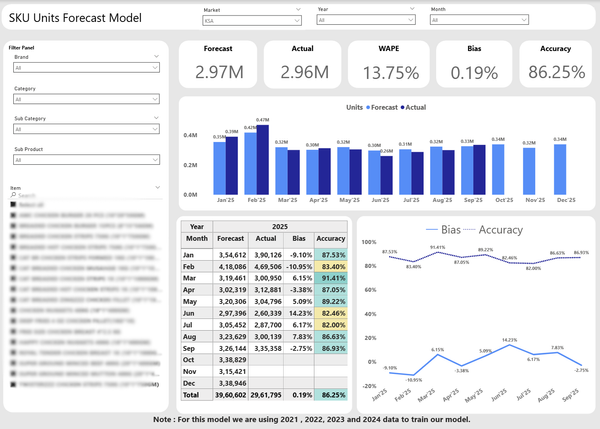
We built a custom machine learning-based forecasting system that integrated historical sales and external data signals to generate more accurate and actionable predictions at the SKU and regional level.
1. Data Pipeline & Feature Engineering
- Ingested three years of historical data from ERP and POS systems
- Engineered features across:
- Seasonality (monthly/weekly patterns, holidays, major sales events)
- Promotions (discount periods, influencer campaigns, flash sales)
- Competitive activity (real-time pricing data from top three competitors)
- Market trends (inflation data, Google Trends, consumer sentiment index)
- External drivers like weather conditions, foot traffic (offline), and ad spend
2. Forecasting Models
- Deployed ML Models for better accuracy
- Models retrained monthly for continuous improvement and adaptability
3. Use Case Integration Across Business Functions
- Supply Chain: SKU-level weekly forecasts guided warehouse distribution and restocking
- Budgeting: Forecasts informed regional and category-level sales planning for finance teams
- Marketing: Dynamic media buying strategies aligned with high-demand windows
- Merchandising: Insights shared with procurement teams to prioritize fast-moving inventory
Quantifiable Results After 6 Months
| Metric | Before ML | After ML | Change |
|---|---|---|---|
| Forecast Accuracy | ~72% | 94% | +22 percentage points |
| Out-of-Stock Incidents | 17/month | 3/month | -82% |
| Overstock Rate | 21% | 9% | -57% |
| Promo ROI | 2.3x | 3.7x | +61% |
| Marketing Efficiency | — | +18% | (Spend aligned to demand curves) |
Business Benefits
- Lean Inventory Management: Reduced working capital tied up in excess inventory
- Forecast-Driven Budgeting: Finance teams developed more accurate quarterly plans using data-backed projections
- Smarter Marketing Investments: Improved ROAS by aligning campaigns with forecasted demand
- Agile Operations: Supply chain teams were able to adjust proactively based on predicted trends
Key Takeaway
By transitioning from static forecasting models to a machine learning-driven forecasting system, the client unlocked significant gains in accuracy, agility, and business foresight. Forecasting evolved from a reactive function to a strategic enabler of growth—driving smarter decisions across supply chain, marketing, and finance.
Would you like to explore how Navtics can transform your business? Netision Experts are here to help you.